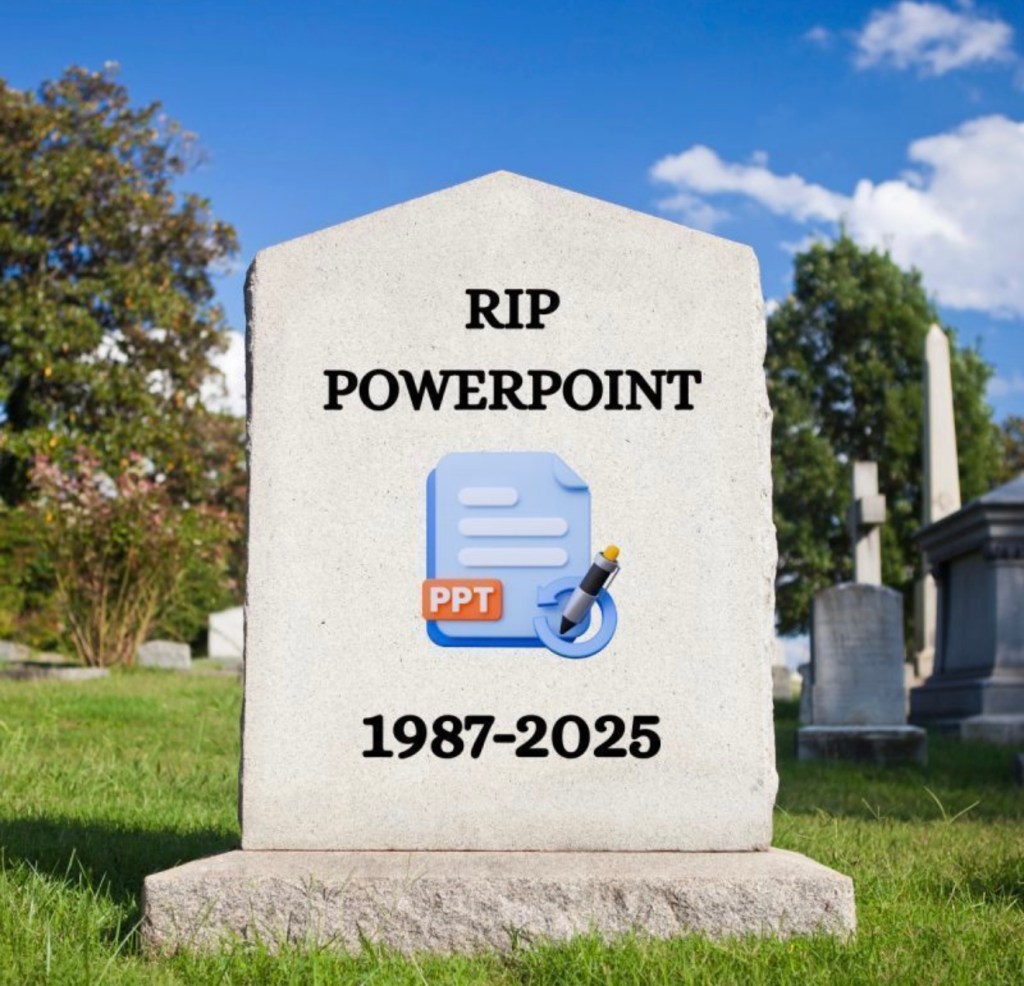
There’s a moment I keep thinking about from the Andrew Huberman Lab podcast, when communication expert Matt Abrahams said something deceptively simple — and profoundly clarifying:
“The slide was the manifestation of your thought process… if it’s just a Franken-deck of pasted figures, there’s no story there.”
That one line crystallized something I’ve felt for years about presentations, storytelling, and investor engagement.
Because somewhere along the way, we collectively decided that slides are the story.
And that decision may be costing founders far more than they realize.
The Pitch Deck Question No One Asks
Let’s pause and ask an uncomfortable question:
Why do companies still build pitch decks the way they do?
Not how — but why.
Is it because it’s truly the best way to communicate innovation, vision, and strategy?
Or is it because someone, somewhere, decades ago decided this was the acceptable format — and we’ve all been following the same script ever since?
Every founder hears it:
“Send me your pitch deck.”
Every investor asks for it.
Every accelerator demands it.
Every startup ends up telling their story in the same 10–15 slides.
So here’s the real question:
Are investors genuinely making decisions based on the same standardized format — or have we just all agreed not to question it?
Are we innovating companies… while presenting them in the least innovative way possible?
Slides Don’t Think — People Do
The problem isn’t slides.
The problem is letting slides drive the thinking.
Too often, decks are built like this:
- Add a market slide
- Add a traction slide
- Add a competitive landscape
- Add some charts
- Hope a story magically appears
What you end up with is exactly what Matt Abrahams warned about:
a Franken-deck — stitched together from parts, but never alive.
Slides are not the narrative.
They are merely the evidence of how you think.
And if there’s no clear thinking — no point of view, no tension, no why — then no amount of visuals will save it.
As author and investor Ben Horowitz has often emphasized in different forms:
The story explains the strategy — and the strategy explains the numbers.
Not the other way around.
Investors Don’t Fund Slides — They Fund Belief
Here’s the part founders underestimate:
Investors aren’t just evaluating data.
They’re evaluating judgment.
They’re asking:
- Do I trust how this person thinks?
- Do they understand the problem deeply?
- Can they navigate uncertainty?
- Can they bring others along?
Those answers don’t come from bullet points.
They come from story.
That’s why some of the most successful founders don’t lead with slides at all.
They lead with:
- a problem that matters
- a tension that demands resolution
- a vision that feels inevitable
As Pixar co-founder Ed Catmull famously said in a different context:
Story is the engine. Everything else supports it.
Investors are no different.
They lean forward when they feel the story is worth listening to.
What If You Gave Investors a Better Experience?
So imagine this:
What if, instead of saying:
“Yes, I have a pitch deck.”
You said:
“I’m going to tell you a story about how we see the world — and why this company has to exist.”
What if the deck didn’t lead the meeting — but followed the narrative?
What if slides were simply supporting characters, not the main act?
That’s the philosophy behind The Main Stage.
We built it to help founders and teams:
- craft the narrative before opening PowerPoint
- communicate purpose, progress, and potential — not just metrics
- replace passive slide-clicking with an experience that feels human, intentional, and memorable
Because innovation shouldn’t be presented like a template.
Great Storytelling Happens Before the Slide Exists
If your slides aren’t expressing your thinking in a way that moves people — emotionally and logically — you’re missing the opportunity to be heard.
Great storytelling doesn’t happen on a slide.
It happens before the slide is ever built.
The slide is simply the artifact of clarity.
So maybe the real question isn’t:
“Can you send me your deck?”
Maybe it’s:
“Can you help me understand how you think?”
And maybe it’s time founders — and investors — started expecting more than just another deck.